Mixing traditional and modern styles in interiors and architecture
How to combine traditional and modern styles in interiors and architecture: principles, world examples, Bulgarian homes, materials and common mistakes.
 Ivan Dyulgerski, architectPublished Updated 5 min read
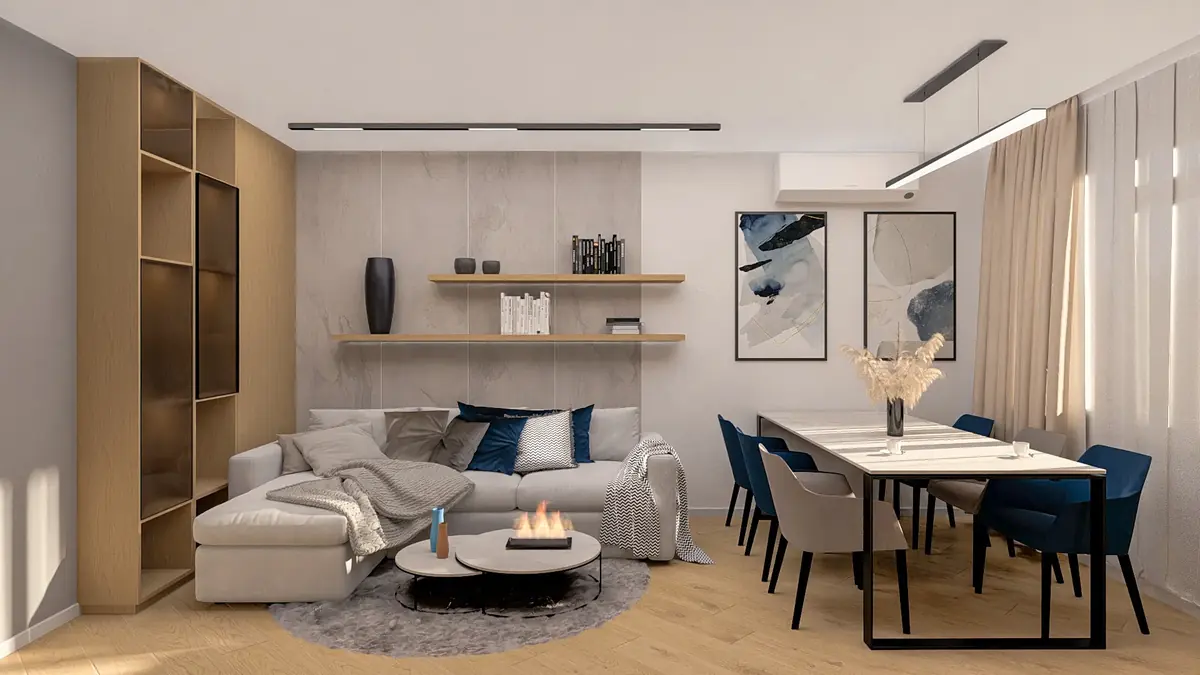
Grandmother's chest of drawers beside a minimalist sofa, a timber ceiling above a handleless white kitchen, a glass extension to a stone house – when it is done well, mixing eras gives a space something no catalogue can: a story.
When it is done badly, the result looks like a furniture warehouse. The difference lies not in taste but in a few principles that can be learnt.
What does it mean to mix traditional and modern styles?
It is the deliberate combination of elements from different eras – forms, materials, furniture, craft details – within one coherent space. In interiors, people sometimes speak of a transitional style, where classic forms are pared back into a calmer, more modern version, and of eclecticism, where the contrast is bolder.
The key word is deliberate. It is not simply about keeping old things, but about choosing which of them carry character and giving them a suitable modern setting.
What are the benefits of mixing styles?
The greatest benefit is that the space gains individuality and depth that are hard to achieve with new things alone.
- Character – old objects and materials carry a patina that new ones lack.
- Memory and identity – a family heirloom, a preserved timber ceiling or a stone wall connect the home to a place and to people.
- Sustainability – reusing furniture and materials means less waste and fewer purchases.
- Flexibility – the interior does not date so quickly, because it does not depend on a single fashion.
- A wealth of textures – wood, stone and fabric set against glass, metal and smooth plaster.
What are some successful examples from around the world?
Some of the most discussed buildings of recent decades are precisely a dialogue between old and new.
- The Louvre Pyramid, Paris – I. M. Pei's glass pyramid in the courtyard of the historic palace. Controversial at first, it is today a symbol of the museum and an example of how a modern form can respect a historic setting through contrast rather than imitation.
- Tate Modern, London – a former power station converted into a museum of contemporary art by Herzog & de Meuron. The industrial brick shell and the vast Turbine Hall were retained, and the new functions were fitted inside.
- The Reichstag, Berlin – the historic parliament building was given a new glass dome designed by Norman Foster, through which visitors can look down into the plenary chamber.
All three show the same thing: the new does not pretend to be old. It is clearly contemporary, yet attuned to the scale, rhythm and spirit of the place.
What does this look like in the Bulgarian context?
In Bulgaria the subject is especially alive. The National Revival houses of Plovdiv, Koprivshtitsa, Zheravna and Melnik, Sofia's old pre-war apartment buildings with high ceilings and herringbone parquet, village houses with stone ground floors and timber verandas – all of them are waiting for a new life.
The typical situations we encounter:
- An old village or country house – the stone masonry and timber beams are kept, while a modern bathroom, kitchen, larger windows and insulation are added.
- An apartment in an old building – the parquet, windows and ornamental ceilings are restored, while the kitchen and bathroom are entirely modern.
- A new home with old belongings – family furniture, rugs, copperware and ceramics within a clean contemporary interior.
For listed buildings or those in conservation areas, any intervention must be approved by the relevant heritage authorities, so it is important for the architect to establish the building's status at the very start.
How do you mix styles step by step?
- Choose the leading style – roughly speaking, one direction should dominate and the other should accent. An even split usually looks indecisive.
- Find the valuable old elements – look at what has real worth: a ceiling, a floor, doors, a fireplace, a piece of furniture, an ornament. These are the stars of the space.
- Give them a calm backdrop – neutral walls and clean modern surfaces let the old elements stand out.
- Create a common language – repeat a colour, material or form in both the old and the new, for example the tone of the wood in an old door and in a new piece of furniture.
- Respect proportions – a massive antique table calls for equally weighty neighbours; slender modern chairs around it need to be numerous enough or expressive enough.
- Use light – contemporary lighting can highlight an old ceiling or stone wall in a way it has never been seen before.
- Review and edit – remove whatever shouts for no reason. In an eclectic interior, leaving things out matters as much as choosing them.
Which materials combine best?
The safest pairings are natural and processed, warm and cool, textured and smooth.
- Timber and glass – old beams and new glazing bring in light without losing warmth.
- Stone and metal – stone masonry with slender steel profiles on doors, balustrades and windows.
- Brick and white plaster – an exposed brick wall in an otherwise clean room.
- Ceramics and concrete – handmade tiles in a contemporary bathroom or kitchen.
- Textiles – rugs, wool and linen soften modern geometry.
What are the most common mistakes?
The most common mistake is the lack of a clear idea: lots of different things that do not talk to one another.
- Imitating the old with new materials, for example plastic "stone" panels next to real stone.
- Too many accents in one room – every object demands attention and none receives it.
- Modern additions that ignore the scale of the historic building.
- Removing valuable original elements in the name of renovation, which can never be brought back.
A good test is simple: photograph the room and look at it on screen. If the eye has nowhere to rest, there are too many accents. If nothing holds it, character is missing. Between these two extremes lies the point where old and new begin to complement each other.
Our approach at DARCH Projects
When we work with old buildings and interiors, we first document what has value and then design the new around it. You can see similar solutions in our projects, and in our interior design work we combine preserved elements with contemporary functions and light.
Frequently asked questions
How do I combine antique furniture with a modern interior?
Choose a few old pieces with character and give them a calm, clean backdrop – light walls, a simple floor, minimalist lighting. Repeat the material or colour of the old piece elsewhere in the room, for example in the tone of the wood or in the textiles. Do not mix too many eras in one room, and leave enough space around valuable pieces for them to be seen.
What is transitional style in interior design?
Transitional style combines classic forms with modern simplicity. The furniture has traditional proportions but cleaner lines and no superfluous decoration. Colours are usually neutral and materials natural. The style suits people who want comfort and elegance but like neither strict minimalism nor an opulent classical interior.
Can an old Bulgarian Revival house have a modern interior?
Yes, and this is often the best way to bring the house back into use. The stone walls, timber ceilings, doors and characteristic details are kept, while the bathroom, kitchen, heating and lighting are resolved in a contemporary way. If the house is a listed monument or in a conservation area, changes must be approved by the relevant authorities, so it is best to start with an architect.
How can a new building fit into an old neighbourhood?
A new building should not copy the old ones but respect the scale, height, window rhythm and materials of its neighbours. Many of the most successful examples are clearly contemporary yet in dialogue with their surroundings – like the Louvre Pyramid. The architect analyses the street, skyline and colours of the neighbourhood and looks for a solution that adds something new without dominating.
Want this for your home?
We will talk through what suits your property, budget and way of life.