Accent colours in interior design: how to create visual interest
What accent colours are, how to choose a shade, where to place it and how much is enough – practical advice for walls, furniture, doors and small rooms.
 Ivan Dyulgerski, architectPublished Updated 5 min read
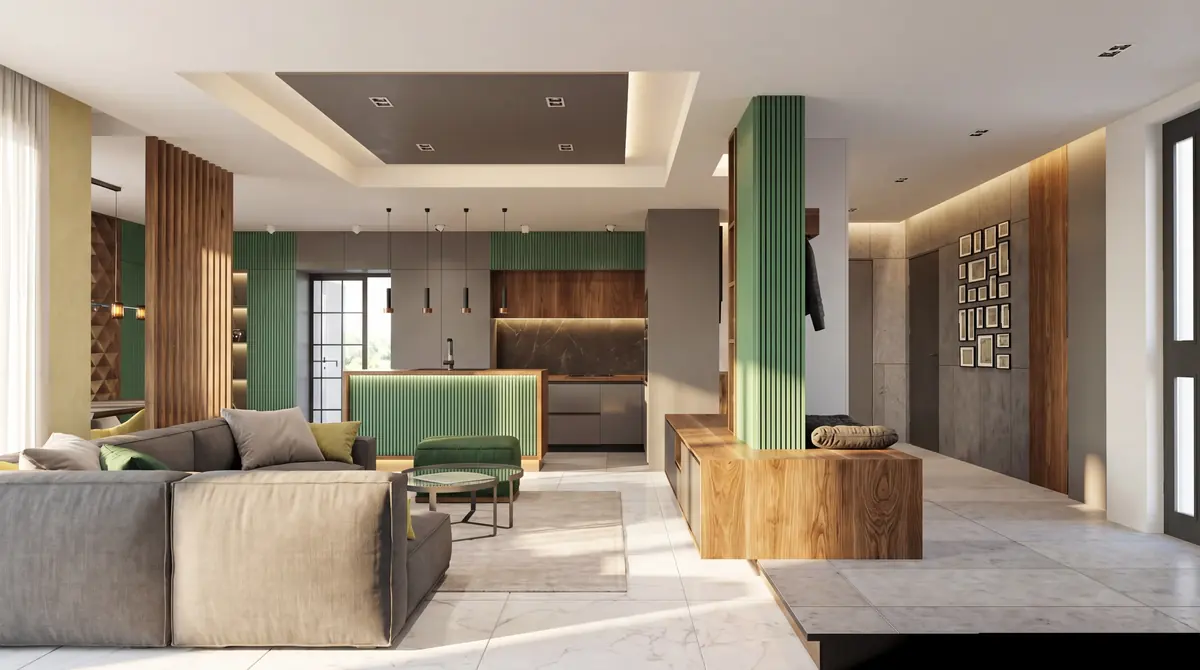
Sometimes a single detail is enough to bring a whole room to life: a yellow armchair in a grey living room, a deep green wall behind the dining table, a blue front door on a white façade. That is the power of an accent colour – a small amount of saturated colour that guides the eye and gives a space its character.
Below we look at what an accent colour actually is, how to pick the right shade, where to put it, how much is “enough” and how to use it even in the smallest rooms.
What are accent colours?
Accent colours are saturated shades used in small quantities to create a focal point and visual interest against a calmer base palette. They do not define the overall character of a room – the walls, floor and large pieces of furniture do that – but they bring it into focus.
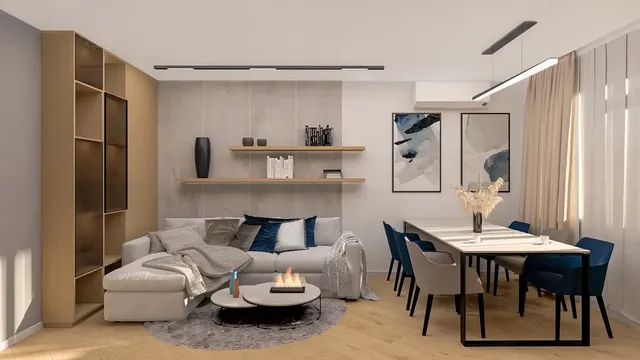
An accent can be bright, such as red or yellow, but it does not have to be. Deep navy, graphite or even black in an otherwise light interior play the same role. What matters is the contrast with the surroundings, not brightness as such.
Accents through material and light
A material with a strong colour of its own can also act as the accent – brass hardware, an exposed brick wall, a marble worktop, solid wood with a warm tone or handmade ceramic tiles. An accent of this kind looks more natural than paint and ages more slowly. The same goes for light: a coloured lamp, a concealed LED strip in a niche or a stained-glass panel can tint part of a room without touching the walls.
How to choose an accent colour
The simplest approach is to choose the accent in relation to the room’s main palette – either as a contrast or as a more saturated version of a tone that is already there.
A complementary colour from the colour wheel
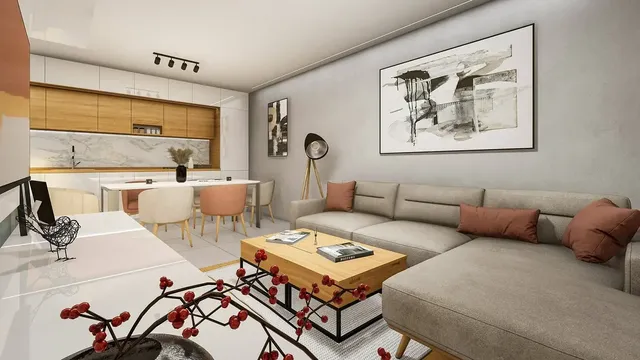
Colours opposite each other on the colour wheel create the strongest contrast: blue and orange, yellow and violet, red and green. If the base is in warm sandy tones, a blue accent will stand out clearly; if it is in cool grey-blues, warm mustard or terracotta will bring it to life.
Analogous colours
A calmer approach is to keep the accent close to the main colour but more saturated – deep olive in a room with pale green walls, for example. The result is harmonious and elegant, without sharp contrast.
A colour taken from a favourite piece
A painting, rug or upholstery fabric you love often suggests the most natural accent. Pick one colour from it and repeat it in one or two other elements in the room.
According to the mood you want
Warm accents – red, orange, yellow – bring energy and suit a dining room, kitchen or social area. Cool ones – blue, green, turquoise – have a calmer effect and feel at home in a bedroom, bathroom or study. If you rent and cannot repaint, rely on textiles, artwork and movable furniture: the effect is almost the same, and the colour moves with you.
Where to place an accent colour
An accent works best where you naturally want to draw the eye – to an architectural detail, a zone or a piece of furniture that deserves attention.
- A single wall – behind the bed, sofa or dining table, or in a niche.
- Doors and frames – an interior door in a rich colour turns a functional element into a decorative one.
- Furniture – an armchair, a chest of drawers, a kitchen island or dining chairs.
- Ceiling – in a bedroom or a small cloakroom WC, a coloured ceiling is a pleasant surprise.
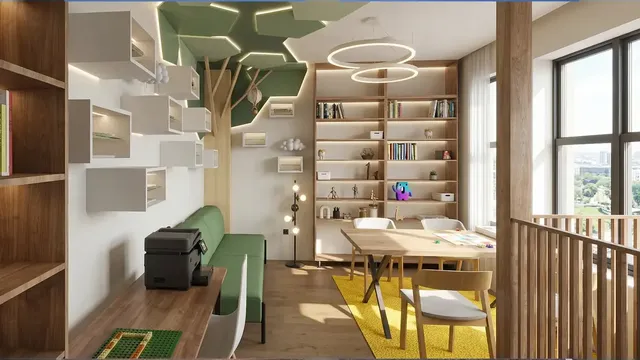
- Staircase and balustrade – in a house, the stair is often the natural “sculpture” of the space.
- Light fittings – a coloured pendant above the table marks out the zone.
- Façade – a front door, window frames or canopy cladding in a different colour give a house individuality.
How much accent is too much?
Accents should be few in number and cover a small share of the visible surface – otherwise they stop being accents and the room becomes noisy. A good guide is around one tenth of the area, as the popular 60–30–10 rule suggests.
Accent wall or accent pieces?
- Accent wall – a strong effect for little outlay, but harder to change and it needs a precisely chosen shade.
- Accent furniture – a longer-term investment; right if you are sure about the colour.
- Textiles and accessories – the most flexible option; easy to swap, but weaker in effect on their own.
A combination often works best: one larger coloured surface supported by two or three small elements in the same colour. Repetition makes the accent look like a deliberate decision. In an open-plan layout, where living, dining and kitchen areas share one space, it is best to keep the same accent colour across all zones – that way they stay connected rather than looking like three separate rooms with different personalities.
How to use accent colours in small rooms
In a small room the accent should be concentrated in one place, with the remaining surfaces light and calm. That way it adds character without making the room feel smaller.
- In a small bathroom – coloured tiles only around the basin or shower.
- In a narrow hallway – a saturated colour on the end wall or on the doors.
- In a small bedroom – a coloured headboard, or wallpaper only behind the bed.
- In a kitchen in a Bulgarian prefab-panel flat, typically compact – a coloured splashback between the units instead of coloured cabinets.
Be careful with warm, highly saturated colours on large surfaces in narrow rooms – they visually pull the walls closer.
How to add an accent colour, step by step
The accent is chosen last, once the base of the room is settled.
- Review the base palette – walls, floor, large furniture and their undertones.
- Find the focal point – the place you want to draw the eye to.
- Choose the colour – contrasting, or a more saturated neighbour of the main colour.
- Decide on the carrier – a wall, furniture, a door or textiles.
- Repeat the accent in one or two smaller elements around the room.
- Check it under different light – saturated colours shift markedly between daylight and artificial light.
How we approach it at DARCH Projects
In our architecture studio, accents are not a last-minute decoration – we plan them together with the layout and the lighting so that they highlight the strongest parts of every interior. Using 3D visualisations, we compare several accent colour options before the decision is final.
Frequently asked questions
Which wall should be the accent wall?
Usually the accent wall is the one the eye naturally goes to on entering the room, or the one framing the main zone – behind the bed in a bedroom, behind the sofa or television in a living room, or behind the dining table. Walls with a niche or an architectural detail also work well. Avoid a wall broken up by several doors and windows, as the effect gets lost.
What accent colour works in a grey room?
Against grey, almost any saturated colour stands out well. Mustard and yellow add warmth and energy, cobalt blue and emerald green look elegant, while coral and terracotta make the room cosier. Take the undertone of the grey into account: bluish greys pair with cool accents, and warm greys with warm ones.
Can a dark colour be an accent?
Yes. An accent does not have to be bright – what matters is the contrast with its surroundings. In a light, almost white interior, navy, graphite, deep green or black act as an accent just as strongly as red. A dark accent adds depth and elegance, especially on the wall behind a bed or in a study.
Do accent colours suit small rooms?
They do, provided the colour is concentrated in one place and the other surfaces stay light and calm – for example, coloured tiles only around the basin in a small bathroom, a saturated end wall in a narrow hallway or a coloured headboard. Avoid strongly saturated warm colours on several walls, as they make the room feel smaller.
Want this for your home?
We will talk through what suits your property, budget and way of life.