Mirrors and glass in interiors: how to make a room feel bigger
Where to hang a mirror, when to choose a glass partition and how glass brightens a small home. Practical ideas for living room, hall, kitchen and bathroom.
 Ivan Dyulgerski, architectPublished Updated 5 min read
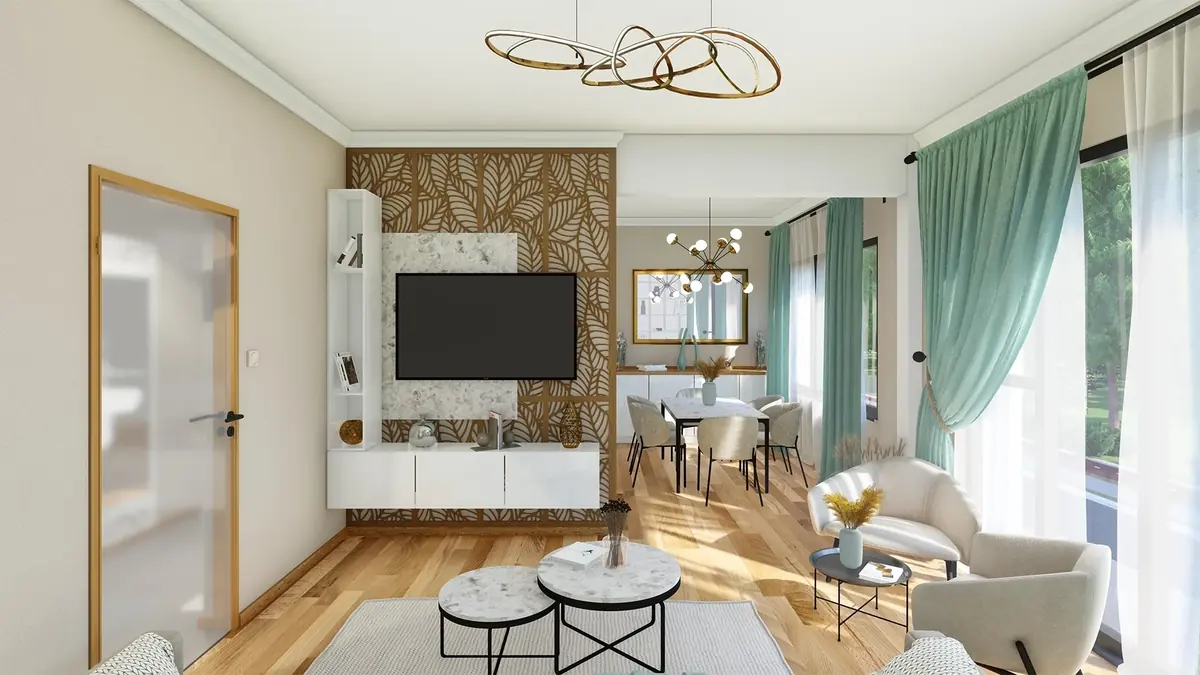
There are two ways to make a room bigger: knock down a wall, or make it look further away. The second is far cheaper and almost always quicker.
Mirrors and glass are the classic tools for the job. They work with light and with the line of sight – multiplying the one and letting the other travel further. Placed at random, though, they can also confuse a space. Here is when and how to use them.
Why do mirrors and glass make a room look bigger?
Because the brain judges the size of a room by its light and by how far the eye can see. A mirror reflects the window, creating the impression of a second light source and of the room continuing beyond the wall. Glass, meanwhile, removes the visual boundary: the wall still divides the space, but the eye carries on through it.
The historic example is the Hall of Mirrors at Versailles – a long gallery in which mirrors facing the windows multiply the light and the view of the gardens. The same principle works in an ordinary corridor in a Bulgarian prefabricated panel block of flats.
Where should a mirror go for the greatest effect?
Ideally beside the window or on a wall perpendicular to it, so that it catches the daylight and spreads it around the room.
Living room
A large mirror behind the sofa or above a sideboard adds depth. Placed directly opposite the window, it doubles the view – excellent when there are trees outside, less so when you are facing the wall of the next block.
Hallway and entrance
Narrow hallways are the most rewarding place for a mirror. A full-height mirror along one wall visually doubles the width and makes the entrance more welcoming.
Bedroom
Mirrored wardrobe doors solve two problems at once – storage and light. Many people, however, dislike seeing their bed in the mirror, so the angle deserves some thought.
Bathroom
The mirror above the basin can be extended along the full length of the vanity top. In a small bathroom without a window, this is the easiest way to make it brighter.
Which mirrors to choose?
- Standard silver mirror – the clearest reflection and the strongest enlarging effect.
- Bronze or grey mirror – warmer and more discreet, well suited to a bedroom or dining room.
- Satin-finish mirror – reflects light but not a sharp image; useful when you don't want to see yourself all the time.
- Antique mirror – with patina and slight mottling, it adds character to a more classic or eclectic interior.
The frame matters too: a slim frame or none at all lets the mirror “disappear” into the wall, while a heavy frame turns it into a picture.
Which mirror mistakes should you avoid?
The golden rule: consider what the mirror will reflect before you hang it.
- Reflecting clutter – a mirror facing shelves full of objects doubles the visual noise.
- Mirror facing mirror – creates an infinite tunnel that is rarely pleasant to live with.
- Too many mirrors – the room starts to resemble a shop or a gym.
- Glare – a mirror that bounces direct sunlight towards the seating area or the television.
- Small mirrors in large frames – enlarging a space takes surface area; a small mirror is decoration rather than a spatial device.
When should you choose a glass partition instead of a wall?
When you want to separate functions but not the light – for example a kitchen from a living room, a study from a lounge, or a bedroom from a windowless hallway.
A comparison of the main options:
- Clear glass – maximum light and openness, but no privacy. Suitable for a study or kitchen.
- Frosted or satin glass – lets light through but hides detail. Suitable for a bathroom, bedroom or walk-in wardrobe.
- Reeded (fluted) glass – blurs the image and adds texture; very much in demand in interiors lately.
- Industrial-style glass with metal frames – a crisp graphic line that highlights the partition as an architectural element.
- Sliding glass doors – let the space stay open during the day and closed in the evening.
Interior partitions and doors use toughened or laminated safety glass – a matter of safety, especially in a home with children.
Glass in the kitchen and bathroom
In the kitchen, a glass splashback is smooth, easy to clean and reflects light, while glass-fronted wall cabinets make the wall feel lighter than a solid row of units. In the bathroom, a clear shower screen instead of a curtain or an enclosed cabin lets the eye take in the whole room – in a small bathroom the difference is considerable.
How to put these ideas into practice, step by step
- Identify the light sources – where the daylight comes from and at what times of day.
- Find the dark zones – a hallway, a windowless bathroom, the deep end of a room.
- Decide on the purpose – do you want light, depth, separation or all of them together?
- Check the reflection – stand where the mirror will go and see what it will reflect from the main seating positions.
- Choose the type of glass – clear, frosted, reeded, safety glass.
- Think about maintenance – glass shows fingerprints and limescale; choose surfaces you will be happy to clean.
- Test it with a visualisation – a 3D model shows the effect of reflections better than any sketch.
What can we learn from architecture?
Modern architecture has long used glass to blur the line between inside and out. Mies van der Rohe's Farnsworth House and Philip Johnson's Glass House are almost entirely glazed and turn the landscape into part of the interior. In a flat there is no need to go that far, but the principle is the same: the fewer solid barriers block the view, the freer a person feels in a space.
The same logic lies behind the internal windows in Sofia's old pre-war apartment buildings and the glazed double doors between living and dining rooms that were typical of homes from the first half of the last century. Back then, without artificial lighting everywhere, architects looked for every possible way to bring daylight into the inner rooms. Today we can draw on that experience with better glass and slimmer frames.
Our approach at DARCH Projects
In our interior design work we plan mirrors and glass together with the lighting and furniture, not as a final accessory. With photorealistic visualisations we check the reflections and daylight before you order the glass.
Frequently asked questions
Where is the best place for a mirror in a small living room?
Ideally on a wall beside the window or perpendicular to it, so it catches the daylight and spreads it around the room. A large mirror behind the sofa or above a sideboard adds depth. Placed directly opposite the window, it will double the view – a good idea if there is greenery outside. Avoid reflecting cluttered shelves or the television.
Is a glass partition safe in a flat with children?
Yes, provided the right glass is used. Interior partitions and doors use toughened or laminated safety glass, which does not break into sharp shards on impact. It is sensible to add a frosted strip or decorative pattern at eye level so the partition is clearly visible. Installation should be carried out by a specialist firm using suitable frames and hardware.
Is a mirrored wardrobe in the bedroom a good idea?
It is practical, because it combines storage, a full-length mirror and more light in the room. Many people, however, dislike seeing their bed in the mirror, especially at night. So it is best to place the wardrobe on a wall that does not directly face the bed, or to mirror only some of the doors. A satin or bronze mirror is a softer solution.
What glass should I choose for a partition between the kitchen and living room?
Clear glass gives the most light and sense of space, but does not hide the kitchen from view. Reeded or frosted glass conceals dishes and mess while still letting light through. Glass in slim metal frames suits industrial and modern interiors. If the kitchen is open-plan and you cook often, the partition also helps keep cooking smells contained.
Want this for your home?
We will talk through what suits your property, budget and way of life.