Natural stone in modern architecture: benefits and uses
Why natural stone remains a valued material: durability, thermal mass and beauty. Pros and cons, types of stone and how to use it in your home.
 Ivan Dyulgerski, architectPublished Updated 5 min read
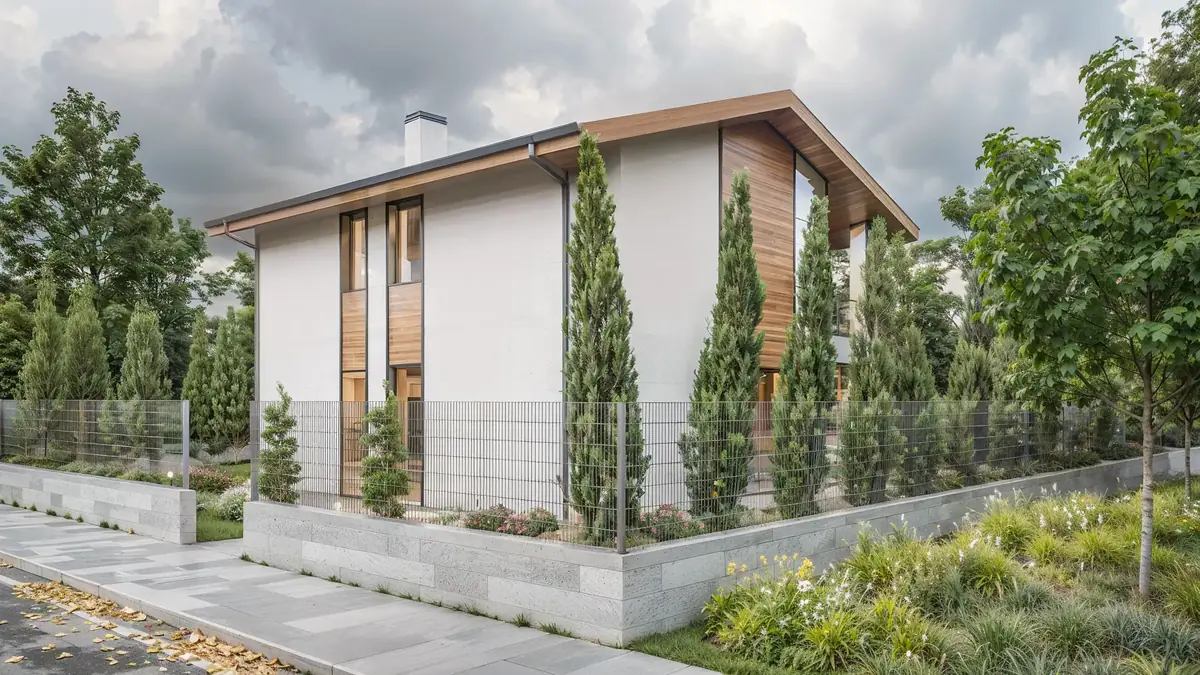
Stone was the first material people trusted when they wanted to build for centuries. Hundreds of years later, in the age of glass, steel and composites, it has not merely survived – architects keep seeking it out for qualities that are hard to imitate.
In Bulgaria stone is part of the building tradition: the stone ground floors of houses from the National Revival period (the 18th–19th centuries), the stone-slab roofs of the Rhodope and Pirin mountains, the cobbled streets of old towns. Contemporary architecture uses it in a new way – thinner, more precisely and in combination with other materials.
What are the benefits of natural stone?
The main advantages of stone are its durability, low maintenance, high thermal mass and an appearance that gets better, not worse, with time.
Durability and longevity
Properly selected and installed stone withstands rain, sun and frost for decades and even centuries. The Colosseum in Rome, built of travertine and concrete nearly two thousand years ago, is the most vivid proof. Stone is also non-combustible.
Thermal mass
Solid stone absorbs heat slowly and releases it slowly. That is why thick stone walls smooth out the difference between day and night – it stays cooler inside in summer, while in winter the wall holds on to the stored heat. An important caveat: stone is not a good thermal insulator. In modern buildings it works alongside insulation, not instead of it.
Beauty that ages well
Every stone is unique in colour, pattern and texture. Over the years its surface acquires a patina that most people find beautiful – unlike many artificial claddings, which fade and crack.
A local, natural material
When stone is quarried nearby, it sits naturally in the landscape and requires less transport. It releases no harmful substances indoors and can be reused when the building is eventually demolished.
What are the drawbacks of stone?
Stone is heavy, requires skilled craftsmen and can be expensive, and some types are sensitive to stains and acids. A brief balance sheet:
- Pros: durability, minimal façade maintenance, non-combustibility, thermal mass, a natural and unique look, and graceful ageing.
- Cons: great weight and the need for good foundations or anchoring, higher material and labour costs, poor insulation, porous types absorb stains, and marble and limestone are sensitive to acids.
Which types of stone are used most often?
The choice depends on where the stone will go: outdoors calls for hard, frost-resistant types, while indoors allows more decorative ones.
- Granite – very hard and resistant; suitable for paving, steps, kitchen worktops and façades.
- Marble – classic and elegant, softer and sensitive to acids; mainly suited to interiors.
- Limestone – warm and easy to work; a well-known Bulgarian example is Vratsa stone, used on a number of prestigious buildings.
- Travertine – with its characteristic pores and warm tone; for paving, cladding and façades.
- Slate and stone slabs – for roofs, paving and mountain-style cladding.
- Rubble stone – for retaining walls, boundary walls, plinths and gardens.
How is stone used in modern buildings?
Today stone is used mainly as cladding, paving and an accent, and less often as a load-bearing wall.
- Ventilated façades – thin stone panels hung on a metal substructure, with insulation behind them.
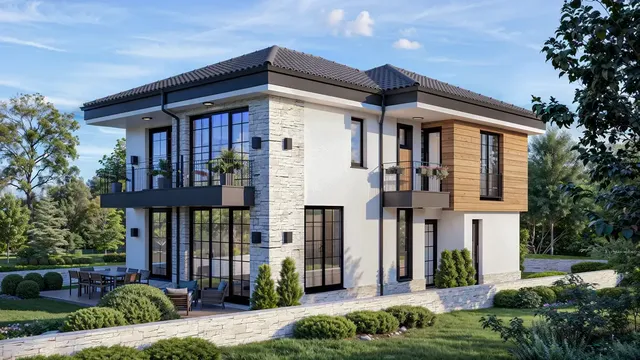
- Plinths and retaining walls – where render suffers from moisture and impact.
- Paving – terraces, courtyards, entrances and bathrooms.
- Interior accents – the wall behind a fireplace, a worktop, a basin, a staircase.
Among the best-known contemporary examples is Peter Zumthor's thermal baths at Vals in Switzerland, built from local quartzite quarried in the valley. Frank Gehry's Guggenheim Museum in Bilbao, meanwhile, pairs its titanium curves with limestone cladding on the more rectilinear parts of the building.
How to choose stone for your house, step by step
The right choice starts with where the stone will be used and the conditions it will face, not with the sample in the showroom.
- Decide where the stone will go. Façade, garden, bathroom, kitchen – each location has different requirements.
- Check its resistance. For outdoor use in the Bulgarian climate, with its frosty winters, it must be frost-resistant.
- Consider slip resistance. Polished stone is beautiful but dangerous on stairs and terraces; choose a textured finish for these.
- View a large sample on site. Colour changes with the light, and natural stone varies from batch to batch.
- Plan the base and fixings. A heavy material needs a properly designed structure or anchoring.
- Plan for maintenance. Porous types are sealed, and marble must be protected from acids.
Is stone a good choice for a house in Bulgaria?
Yes, stone is an excellent choice for the Bulgarian climate, provided it is selected according to the altitude, humidity and frost exposure of the specific site. In the mountains, a stone plinth and stone walls continue the local tradition, while in the city thin stone cladding adds durability and a sense of quality to the façade. The best results come from combining stone with timber, glass and modern insulation.
Lessons from the traditional house
The old houses in villages such as Kovachevitsa and Leshten, and in the Revival-era quarters of Plovdiv, show a logic that still holds today: a solid stone ground floor that takes the moisture from the ground and keeps out the cold, and an upper floor with more timber and windows, often with projecting bay windows. Stone was placed where it was needed most – in the foundations, plinth, boundary walls and roof. A modern house can follow the same principle: stone at the bottom and wherever there is impact, moisture and snow, with lighter and warmer materials above.
Stone in interiors
Indoors, stone works best as an accent – the wall behind a fireplace, a kitchen worktop, a bathroom basin or a flight of steps. A single stone surface in a calm setting of timber and plaster is more striking than an entire room clad in stone.
How we work with stone at DARCH Projects
In our projects we use stone where it contributes most – plinths, feature walls, paving and interior details – and combine it with modern insulation solutions. With photorealistic visualisations we check how a particular stone looks under different light before it is ordered. Browse our projects or find out more about architectural design.
Frequently asked questions
Is stone a good thermal insulator?
No. Stone has high thermal mass, meaning it stores and releases heat slowly, which evens out temperature swings indoors. But it conducts heat relatively well, so it is not a good insulator. In modern buildings, a stone wall or cladding is combined with insulation so that the home is both comfortable and energy-efficient.
Which natural stone is best for a façade?
For façades, choose hard, dense types that resist frost and moisture – for example granite, certain dense limestones and travertine, as well as slate. The choice also depends on the climate, the look you want and the fixing method, such as a ventilated façade or adhesive fixing. Before ordering, view a large sample on site and check the technical properties of the specific batch.
Is natural stone expensive to use?
Natural stone is usually more expensive than render or artificial cladding, and installation requires skilled craftsmen. In return, it lasts for decades with almost no maintenance. A sensible approach is to use stone selectively – for the plinth, the entrance, a feature wall or terrace paving – rather than everywhere, so that it makes the greatest impact on a more controlled budget.
Can natural stone be used in the bathroom and kitchen?
Yes, but the type must be chosen carefully. Granite is very hard-wearing and well suited to kitchen worktops. Marble and limestone are beautiful but sensitive to acids such as lemon juice and vinegar, so they need more care. In bathrooms, porous stones are sealed, and floors are given a textured, non-slip finish.
Want this for your home?
We will talk through what suits your property, budget and way of life.