Stone and wood in design: how to combine them in your home
How to combine stone and wood inside and on the façade: suitable types, balance, upkeep, classic examples and the mistakes to avoid in the design.
 Ivan Dyulgerski, architectPublished Updated 5 min read
Few materials share as long a history as stone and wood. From the houses of Bulgaria's Rhodope Mountains, with their stone ground floor and timber upper storey, to the most famous modern villas, the pairing keeps returning in architecture because it simply works.
But “works” does not mean that every combination succeeds. The difference between a warm, calm home and a heavy, gloomy space lies in the proportions, the types chosen and the detailing.
Why do stone and wood go so well together?
Because they are opposite in character and balance each other. Stone is heavy, cold to the touch, durable and visually “grounding”. Wood is lighter, warm, soft to the touch and alive – it changes colour over time.
- Contrast of textures – rough stone next to smooth or brushed timber.
- Contrast of temperature – cool greys and beiges against the honey and walnut tones of wood.
- Connection with nature – both materials come straight from the landscape and sit easily within it.
- Ageing gracefully – well chosen, they become more beautiful with the years rather than more worn.
What are the classic examples in architecture?
The most frequently cited example is Frank Lloyd Wright's Fallingwater in Pennsylvania. Its walls and massive fireplace are built from local sandstone, laid to echo the rock strata around the waterfall, while the interior is fitted with built-in walnut furniture. The house shows how the two materials can literally continue the landscape.
There is no need to look so far afield. The traditional Bulgarian house in the Rhodopes, Bansko, Melnik or Zheravna is a textbook of the same principle: a stone ground floor that takes the moisture and the load, and a lighter, warmer timber upper floor with a covered veranda (chardak). The materials are arranged logically – stone below, where it is damper and more heavily loaded, timber above, where it is dry and sunny.
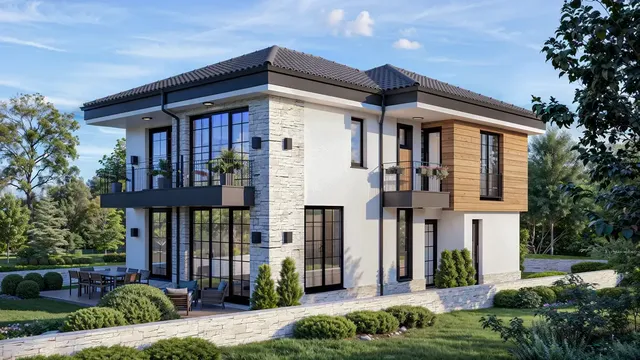
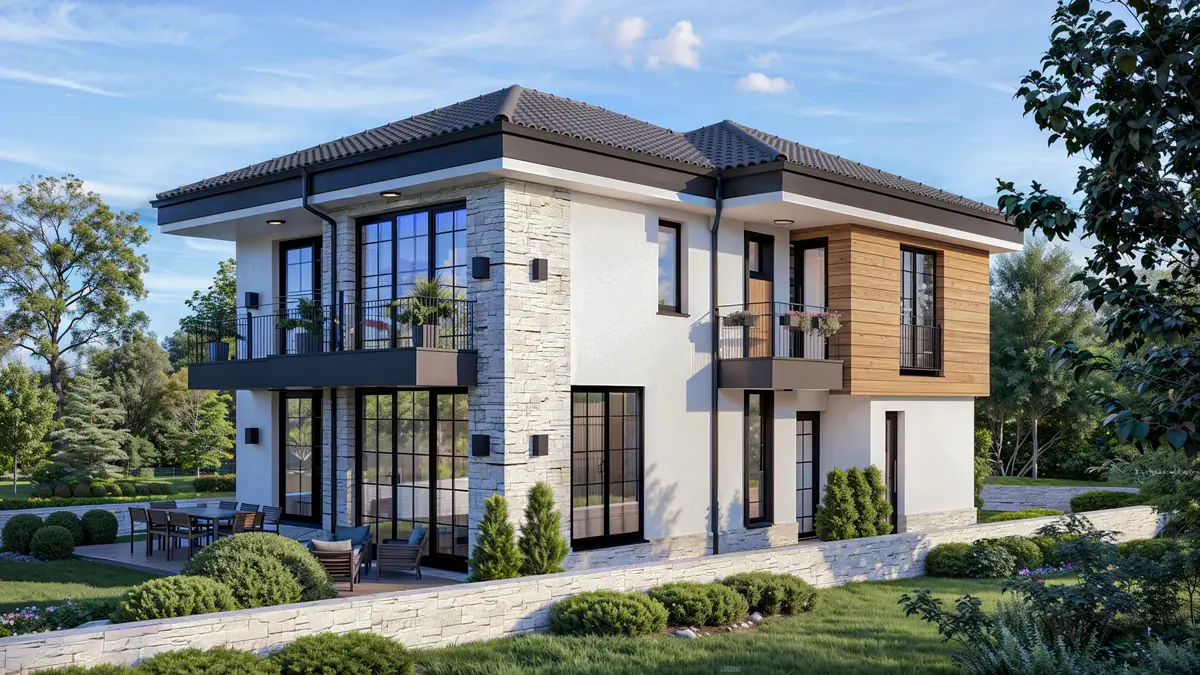
Contemporary mountain houses and villas often continue this logic in a modern form: a stone plinth or wall, timber cladding and large glazed openings.
How can you use stone and wood on the façade?
On the façade, what matters most is which material leads and how each is protected from the weather.
- Stone plinth with timber cladding above – the most logical solution: the stone takes the splash from rain and snow, and the timber stays dry.
- A stone volume and a timber volume – two parts of the house clad in different materials emphasise the composition.
- A stone wall with timber shutters or louvres – the wood becomes a regulator of light and shade.
For façade timber, choose more durable species or thermally modified wood, and make sure the details allow ventilation and water run-off. Good detailing matters more than expensive material.
How do you combine stone and wood in the interior?
Indoors the rule is the reverse of the façade: wood usually dominates and stone is the accent. Too much stone inside easily makes a room cold and noisy.
Living room and fireplace
A stone fireplace, or a stone wall behind it, is the classic focal point of the living room. A timber floor, a beamed ceiling or timber panelling around it adds warmth. Keep the stone to one wall rather than using it everywhere.
Kitchen
A stone worktop resists heat and scratches, while timber cabinet fronts soften the kitchen. The reverse – a timber worktop – is warmer but needs more care around the sink and hob.
Bathroom
A stone floor or wall in the bathroom is natural and durable. Wood here is for accents – a vanity top, a shelf, a bench – and must be a suitable species, well sealed and kept away from direct water flow.
Bedroom
Timber on the floor and in the furniture creates calm, while a stone bedside table or feature wall adds character without cooling the space.
How do you choose the right types of stone and wood?
Choose them according to location, wear and the upkeep you are prepared to do. Here is a practical sequence:
- Define the location – façade, floor, wall, worktop, fireplace. Each has different requirements.
- Consider moisture and wear – an entrance or terrace floor, a worktop by the sink and a living room wall are very different situations.
- Choose the lead material – roughly speaking, one should dominate and the other complement it.
- Match the tones – warm stone with lighter wood, or cool grey stone with darker wood, gives balance; two similar tones merge.
- View samples on site – stone and wood look different in daylight, under lamps and when wet.
- Check the upkeep – some stones absorb stains and need sealing, while wood needs oil or varnish.
- Plan the detail – how the two materials meet, how water drains away, where the joints are.
Local materials have an advantage: shorter transport and a natural fit with the landscape, especially for a house in the mountains or a village.
Common mistakes when combining them
- Imitations next to real materials – laminate with a “wood” print next to natural stone instantly gives itself away.
- Too many types – three kinds of stone and four kinds of wood in one room create noise instead of character.
- Lack of light – dark stone and dark wood in a room with small windows make it gloomy; lighter tones and well-planned lighting help here.
- Neglected detailing – timber resting directly on wet stone or on the ground deteriorates quickly.
What are the pros and cons of the combination?
Pros
- Durability and natural beauty that does not look “fashionable” for just one season.
- A warm, cosy atmosphere, especially in mountain houses and villas.
- A good fit with natural surroundings.
Cons
- Natural stone is heavy and may require a check of the structure.
- Both materials need upkeep – sealing, oiling, cleaning.
- Quality materials and the craftsmen to work them are not the cheapest option.
- Too much of either makes a space heavy and dark.
How we approach it at DARCH Projects
When designing houses we treat stone and wood as part of the architecture – where they go, how they are protected and how they age. With 3D visualisations we show the combinations on the façade and in the interior under different light, before you choose the specific materials.
Frequently asked questions
What wood goes with grey stone?
Cool grey stone is well balanced by warmer wood – oak, walnut or darker tones that bring a sense of comfort. Pale Scandinavian-style timber also works if you want a fresher, more minimalist look. What matters is that the two materials are not too close in tone, or they will merge. Look at the samples together in daylight, in the room where they will be used.
Is a stone wall in the living room a good idea?
Yes, if it is a single feature wall – around the fireplace or behind the television, for instance. Stone adds texture and character, but across the whole room it can make it cold, dark and noisy. Pair it with a timber floor, textiles and warm lighting. With natural stone, check whether the wall can carry the weight, or use thinner cladding slabs.
How do you protect timber on a façade?
Choose a suitable species or thermally modified timber and a protective finish that is renewed periodically. Detailing matters even more: the cladding should be ventilated behind, should not touch the ground, and should be shielded from splash by a stone or concrete plinth and a generous roof overhang. The timber then greys evenly and naturally instead of rotting.
Which famous buildings combine stone and wood?
The best-known example is Frank Lloyd Wright's Fallingwater in Pennsylvania – stone walls and a fireplace in local sandstone, with an interior of built-in walnut furniture. In Bulgaria, the traditional houses of the Rhodopes, Bansko, Melnik and Zheravna are excellent examples: a stone ground floor and a timber upper floor that have demonstrated the logic of the two materials for centuries.
Want this for your home?
We will talk through what suits your property, budget and way of life.